Analysis of Algorithms Question Paper – Complete Exam Guide for B.Tech Students
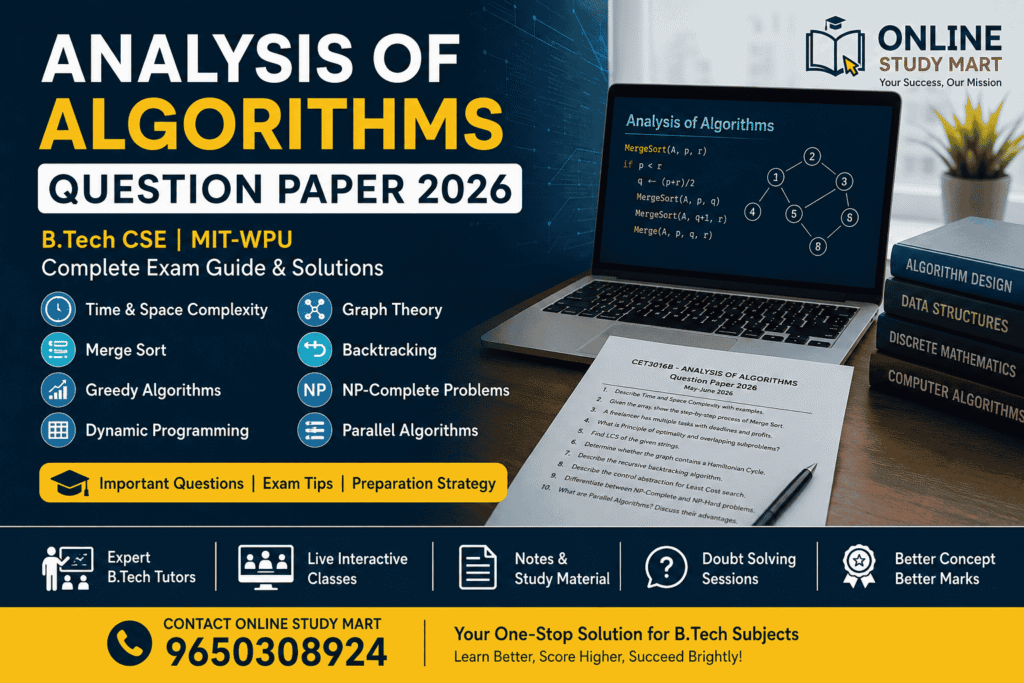
The Term End Examination May-June for CET3016B – Analysis of Algorithms conducted by MIT World Peace University (MIT-WPU) included several important topics from the B.Tech Computer Science Engineering syllabus. This paper tested students on core algorithmic concepts such as sorting algorithms, dynamic programming, graph theory, greedy algorithms, NP-Completeness, backtracking, and parallel algorithms.
If you are preparing for upcoming university exams, this question paper is highly useful for understanding the exam pattern, important topics, and expected problem-solving approach.
At Online Study Mart, we provide expert guidance for B.Tech subjects including Analysis of Algorithms, Data Structures, Operating Systems, DBMS, Computer Networks, Engineering Mathematics, and more.
📞 Call/WhatsApp: 9650308924
Overview of the Question Paper
The paper was divided into short descriptive and problem-solving questions carrying 5 marks each. Students were required to explain concepts, solve algorithmic problems, and apply theoretical knowledge.
Major topics covered in the paper:
- Time and Space Complexity
- Merge Sort
- Greedy Method
- Dynamic Programming
- Longest Common Subsequence (LCS)
- Hamiltonian Cycle
- Backtracking
- Branch and Bound
- NP-Complete and NP-Hard Problems
- Parallel Algorithms
These are among the most important units in the Analysis of Algorithms syllabus for B.Tech CSE students.
Question 1: Time and Space Complexity with Asymptotic Notations
The paper started with a theoretical question on:
- Time Complexity
- Space Complexity
- Big-O Notation
- Theta Notation
- Omega Notation
Important Concepts
Time Complexity
Time complexity measures the amount of time an algorithm takes to execute as the input size increases.
Examples:
- Linear Search → O(n)
- Binary Search → O(log n)
- Bubble Sort → O(n²)
Space Complexity
Space complexity refers to the memory consumed by an algorithm during execution.
Asymptotic Notations
Big-O Notation
Used to represent the upper bound of complexity.
T(n)=O(f(n))
Theta Notation
Represents the exact bound.
T(n)=\Theta(f(n))
Omega Notation
Represents the lower bound.
T(n)=\Omega(f(n))
This question is extremely important for university exams and viva sessions.
Question 2: Merge Sort Step-by-Step Process
Students were asked to sort the array:
[58, 97, 53, 13, 29, 87, 10]
using Merge Sort and calculate recursion levels.
Merge Sort Overview
Merge Sort follows the Divide and Conquer strategy.
Steps:
- Divide the array into halves
- Recursively sort each half
- Merge sorted halves
Time Complexity of Merge Sort
T(n)=2T\left(\frac{n}{2}\right)+n
Final Sorted Array
[10, 13, 29, 53, 58, 87, 97]
Complexity
- Best Case: O(n log n)
- Worst Case: O(n log n)
- Stable Sorting Algorithm
Merge Sort is one of the most commonly asked algorithms in B.Tech university exams and coding interviews.
Question 3: Job Sequencing with Deadlines (Greedy Method)
This question involved maximizing profit using the Greedy Method.
Given Tasks
| Task | Deadline | Profit |
|---|---|---|
| T1 | 4 | 20 |
| T2 | 1 | 10 |
| T3 | 2 | 40 |
| T4 | 2 | 30 |
Solution Strategy
Tasks are arranged according to maximum profit:
- T3 → 40
- T4 → 30
- T1 → 20
- T2 → 10
Optimal sequence:
- T3
- T4
- T1
Maximum Profit
40 + 30 + 20 = 90
Greedy algorithms are highly important for:
- Scheduling problems
- Optimization
- Resource allocation
Question 4: Principle of Optimality and Overlapping Subproblems
This was a theory-based Dynamic Programming question.
Principle of Optimality
A problem can be solved optimally if its subproblems are solved optimally.
Overlapping Subproblems
Dynamic Programming stores repeated computations to avoid recalculations.
Examples:
- Fibonacci Series
- Knapsack Problem
- Matrix Chain Multiplication
- LCS Problem
Dynamic Programming is one of the most scoring topics in Analysis of Algorithms.
Question 5: Longest Common Subsequence (LCS)
Strings:
- X = “BCDGTAB”
- Y = “AXDGAYB”
LCS Result
DGAB
LCS Formula
LCS(i,j)=\begin{cases}0 & i=0\text{ or }j=0\1+LCS(i-1,j-1) & X_i=Y_j\\max(LCS(i-1,j),LCS(i,j-1)) & X_i\ne Y_j\end{cases}
Complexity
- Time Complexity: O(m × n)
- Space Complexity: O(m × n)
LCS is frequently asked in:
- University exams
- Coding interviews
- Competitive programming
Hamiltonian Cycle in Graph Theory
The second page contained an important graph problem asking students to determine whether the graph contains a Hamiltonian Cycle.
What is a Hamiltonian Cycle?
A Hamiltonian Cycle is a cycle that visits every vertex exactly once and returns to the starting vertex.
This topic belongs to:
- Graph Theory
- Backtracking Algorithms
Hamiltonian problems are important for:
- Route optimization
- Network design
- Traveling Salesman Problem
Recursive Backtracking Algorithm
Students were asked to explain recursive backtracking and its general structure.
Backtracking Concept
Backtracking tries all possible solutions and abandons paths that do not satisfy conditions.
Applications
- N-Queens Problem
- Sudoku Solver
- Graph Coloring
- Hamiltonian Cycle
General Structure
- Choose
- Explore
- Backtrack
Backtracking is an important concept in advanced algorithm design.
Least Cost Search in Branch and Bound
Branch and Bound is used for solving optimization problems efficiently.
Key Concepts
- State Space Tree
- Live Nodes
- Dead Nodes
- Cost Function
Applications:
- Traveling Salesman Problem
- 0/1 Knapsack
- Assignment Problems
NP-Complete vs NP-Hard Problems
This is one of the most important theory questions in Analysis of Algorithms.
NP-Complete
Problems that are:
- In NP
- NP-Hard
Examples:
- SAT Problem
- Hamiltonian Cycle
- Clique Problem
NP-Hard
Problems harder than NP-complete.
Examples:
- Traveling Salesman Optimization Problem
This topic is frequently asked in:
- Semester exams
- Gate exams
- Technical interviews
Parallel Algorithms
The final question discussed Parallel Algorithms and their advantages.
What are Parallel Algorithms?
Algorithms that execute multiple operations simultaneously using multiple processors.
Advantages
- Faster execution
- Better resource utilization
- High performance computing
Applications
- Artificial Intelligence
- Big Data Processing
- Scientific Simulations
- Cloud Computing
Parallel computing is becoming increasingly important in modern software systems.
Important Topics to Prepare for Analysis of Algorithms
Students preparing for B.Tech university exams should focus on:
- Sorting Algorithms
- Divide and Conquer
- Dynamic Programming
- Greedy Algorithms
- Graph Algorithms
- Backtracking
- Branch and Bound
- Complexity Analysis
- NP-Complete Problems
- Parallel Algorithms
Why Choose Online Study Mart for B.Tech Tuition?
Online Study Mart provides expert online tuition for engineering students across India.
Subjects Covered
- Analysis of Algorithms
- Data Structures
- DBMS
- Operating Systems
- Computer Networks
- Engineering Mathematics
- Theory of Computation
- Compiler Design
Features
- Live Interactive Classes
- University Exam Preparation
- Important Questions & Notes
- Doubt Solving Sessions
- One-to-One Mentorship
- Recorded Lectures
Whether you are preparing for semester exams, backlogs, assignments, or placements, our expert B.Tech tutors help students score better marks and improve conceptual understanding.
📞 Contact Online Study Mart: 9650308924
Conclusion
The Analysis of Algorithms Question Paper 2026 focused on both theoretical understanding and practical problem-solving. Topics like Merge Sort, Dynamic Programming, Greedy Algorithms, Graph Theory, and NP-Completeness continue to dominate university examinations.
Students should practice previous year question papers regularly and strengthen their understanding of algorithm design techniques.
For professional guidance, exam preparation, and online tuition for B.Tech subjects, connect with Online Study Mart today.
📞 Call/WhatsApp: 9650308924