Bennett University
School of Engineering & Applied Sciences
B.Tech – Probability and Statistics
Time: 3 Hours
Maximum Marks: 70
Instructions:
-
Attempt ALL questions from Section A
-
Attempt ANY FIVE questions from Section B
-
Use of non-programmable calculator is allowed
-
Assume suitable data if required
Section A (10 × 2 = 20 Marks)
Attempt all questions
-
Define a random experiment with an example.
-
What is a sample space?
-
Define conditional probability.
-
State Bayes’ Theorem.
-
What is a random variable?
-
Define probability density function (PDF).
-
What is mathematical expectation?
-
Define variance of a random variable.
-
What is Poisson distribution?
-
Define correlation coefficient.
Section B (5 × 10 = 50 Marks)
Attempt any FIVE questions
Q11. Probability Theory
(a) State and prove the Addition Theorem of Probability.
(b) If P(A) = 0.6, P(B) = 0.4 and P(A ∩ B) = 0.2, find:
(i) P(A ∪ B)
(ii) P(A | B)
Q12. Bayes’ Theorem
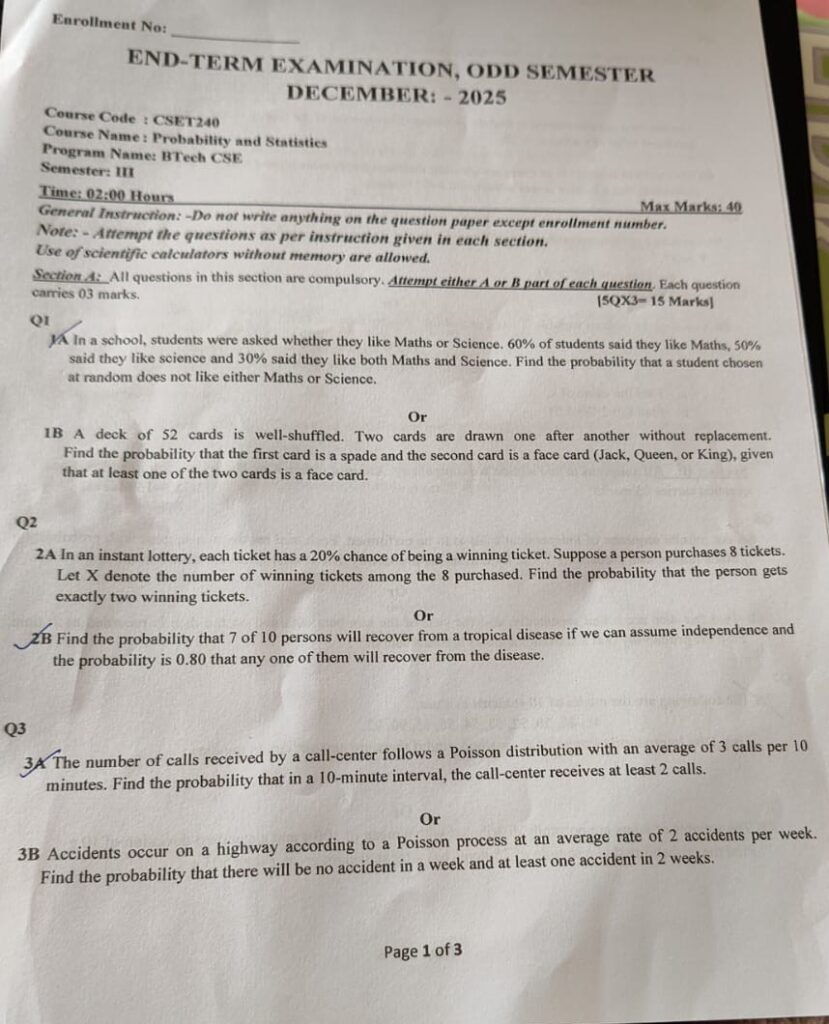
A factory has three machines A, B, and C producing 30%, 45%, and 25% of total output respectively. The percentage of defective items produced by these machines are 2%, 3%, and 5% respectively.
Using Bayes’ Theorem, find the probability that a randomly selected defective item was produced by machine B.
Q13. Random Variables
(a) Define discrete and continuous random variables.
(b) The probability distribution of a random variable X is given as:
| X | 0 | 1 | 2 | 3 |
|---|---|---|---|---|
| P(X) | 0.1 | 0.2 | 0.4 | 0.3 |
Find:
(i) Mean
(ii) Variance
Q14. Continuous Distribution
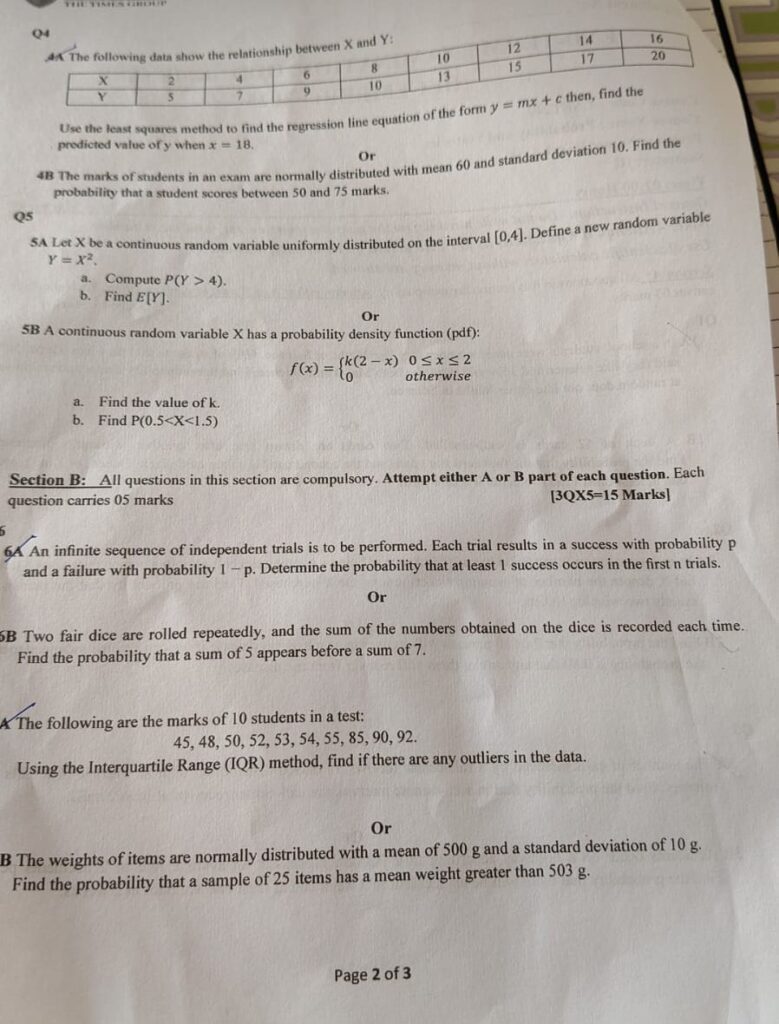
The probability density function of a random variable X is given by
f(x) = kx², 0 ≤ x ≤ 1
(a) Find the value of k
(b) Find the mean of X
Q15. Binomial Distribution
(a) Define Binomial Distribution and write its mean and variance.
(b) A fair coin is tossed 5 times. Find the probability of getting:
(i) Exactly 3 heads
(ii) At least 2 heads
Q16. Poisson Distribution
The average number of accidents at a crossing is 3 per month. Find the probability that in a given month:
(a) There will be no accidents
(b) There will be at least 2 accidents
Q17. Correlation and Regression
(a) Define correlation and explain types of correlation.
(b) Calculate Karl Pearson’s coefficient of correlation for the following data:
| X | 10 | 12 | 14 | 16 | 18 |
|---|---|---|---|---|---|
| Y | 20 | 24 | 28 | 30 | 34 |
Q18. Curve Fitting
Fit a straight line y = a + bx using the method of least squares for the following data:
| x | 1 | 2 | 3 | 4 | 5 |
|---|---|---|---|---|---|
| y | 2 | 5 | 7 | 9 | 11 |
✅ Topics Covered
-
Probability & Bayes’ Theorem
-
Random Variables
-
Discrete & Continuous Distributions
-
Binomial & Poisson Distribution
-
Expectation & Variance
-
Correlation & Regression
-
Curve Fitting