
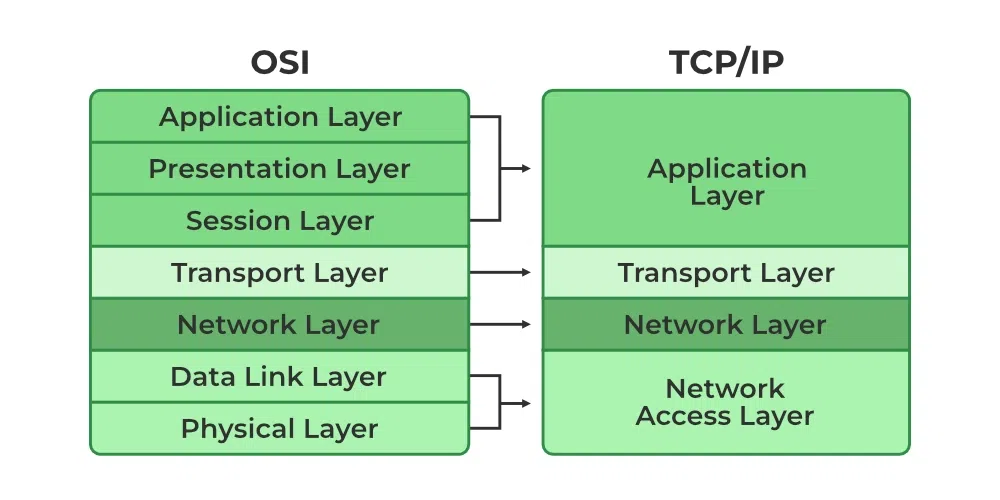
Difference between OSI Reference model and TCP Model
The OSI Reference Model and the TCP/IP Model are two foundational models for understanding and implementing network communication protocols. Here are the key differences between them:
1. Number of Layers
| Aspect | OSI Model | TCP/IP Model |
|---|---|---|
| Layers | 7 layers | 4 layers |
| Details | Physical, Data Link, Network, Transport, Session, Presentation, and Application. | Network Interface, Internet, Transport, and Application. |
2. Purpose and Design
| Aspect | OSI Model | TCP/IP Model |
|---|---|---|
| Purpose | Conceptual model for standardizing communication. | Practical implementation of networking protocols. |
| Design | A reference model, not directly tied to protocols. | Protocol-oriented, designed to enable communication over the Internet. |
3. Protocol Dependency
| Aspect | OSI Model | TCP/IP Model |
|---|---|---|
| Protocol Independence | Independent of protocols, provides a framework for development. | Protocol-specific, tied to Internet protocols like TCP, IP, HTTP, etc. |
4. Usage and Adoption
| Aspect | OSI Model | TCP/IP Model |
|---|---|---|
| Adoption | Used as a theoretical reference. | Widely implemented and used in real-world networking. |
5. Layers and Mapping
| OSI Layers | TCP/IP Layers | Examples of Protocols |
|---|---|---|
| Application | Application | HTTP, FTP, DNS |
| Presentation | Combined into Application | Data formatting, encryption (e.g., SSL/TLS) |
| Session | Combined into Application | Session management (e.g., RPC, NetBIOS) |
| Transport | Transport | TCP, UDP |
| Network | Internet | IP, ICMP |
| Data Link | Network Interface | Ethernet, Wi-Fi |
| Physical | Network Interface | Cables, switches |
6. Flexibility and Scope
| Aspect | OSI Model | TCP/IP Model |
|---|---|---|
| Flexibility | More structured and detailed; not bound to specific protocols. | Flexible and practical, focused on end-to-end communication. |
| Scope | Covers all aspects of network communication in detail. | Focused on efficient communication over the Internet. |
Summary
- The OSI Model is ideal for understanding networking concepts and separating functionalities across layers.
- The TCP/IP Model is a simplified, real-world implementation that serves as the foundation for the modern Internet.